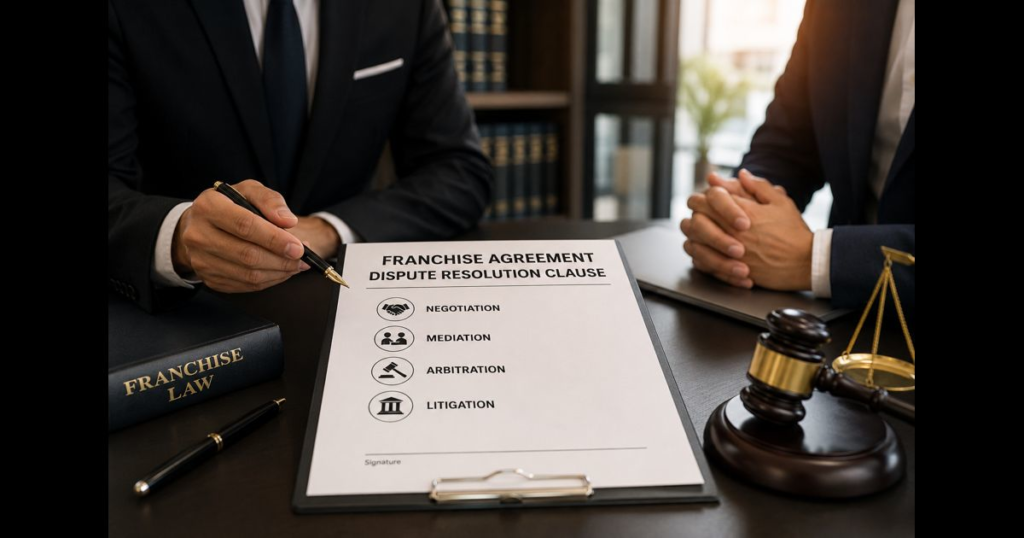
A franchise agreement may require a dispute to pass through written notice, internal negotiation and mediation before either party can begin litigation. Mediation Clauses in Franchise Agreements therefore affect more than the possibility of settlement: their wording can determine when a claim may be filed, who must receive notice, where the process occurs and what procedural response may follow if a required step is skipped.
Mediation is distinct from arbitration. A mediator ordinarily facilitates negotiation without deciding the dispute, while an arbitrator may be authorized to issue a binding decision. Yet an agreement can make participation in mediation mandatory even though neither party is required to accept a settlement.
The practical question is not simply whether an agreement mentions mediation. It is what the provision requires, when it applies, how completion is defined and how the clause interacts with governing law, incorporated rules and filing deadlines.
Why the Dispute-Resolution Clause Deserves Separate Review
A dispute-resolution section may look like standard contract language, but it can regulate the path to a court or arbitral forum. Its effect depends on the full sequence created by the agreement, not on the heading alone.
A close review should identify:
- the order in which notice, negotiation, cure and mediation must occur;
- deadlines for starting or completing each stage;
- approved notice addresses and delivery methods;
- the location, administrator and applicable mediation rules;
- which parties and claims are covered;
- how mediator and administrative costs are allocated; and
- what the agreement permits after an unsuccessful mediation.
Related agreements may expand the analysis. A personal guaranty, area-development agreement, confidentiality agreement or supply contract may contain its own dispute terms or incorporate the franchise agreement’s procedures.
Noncompliance does not produce one universal result. A court may stay proceedings, direct the parties to complete the agreed process, dismiss claims or decline enforcement because the clause does not cover the dispute. Exact wording and documented conduct matter.
Negotiation, Mediation, Arbitration and Litigation Are Different Processes
The U.S. Courts Glossary describes mediation as an informal process in which a mediator facilitates negotiations, while arbitration involves a neutral decision-maker who may issue a binding or nonbinding judgment depending on the parties’ agreement.
| Process | Who controls the outcome | Typical role | Possible result | Key contractual question |
| Negotiation | The parties | Direct discussion without a neutral decision-maker | Agreement, partial agreement or impasse | Is direct discussion or executive escalation required first? |
| Mediation | The parties retain settlement authority | A neutral facilitates negotiation | Settlement of all or some issues, or no settlement | Must the parties participate before filing another proceeding? |
| Arbitration | The arbitrator decides submitted issues | Adjudication outside court under agreed rules | Binding or nonbinding award, depending on the agreement | Which claims must be arbitrated, and under which rules? |
| Litigation | A judge or jury decides disputed legal and factual issues | Public court process governed by jurisdictional and procedural rules | Judgment, dismissal, settlement or another court order | Does the contract permit suit at this stage and in this forum? |
A clause requiring mediation does not compel settlement. It can require the parties to participate in a defined process while leaving each party free to reject proposed terms.
How a Staged Franchise Dispute Process May Work
A franchise agreement can create a sequence resembling the following:
- One party sends a written notice describing the dispute.
- Designated representatives discuss the matter informally.
- A contractual waiting, cure or negotiation period runs.
- A party submits a formal mediation demand.
- The parties or an administering organization select a mediator.
- The mediation session occurs.
- Arbitration or litigation becomes available if the dispute remains unresolved.
This is only an illustration. Some agreements omit negotiation, give one party the option to elect mediation, create exceptions for emergency relief or define completion through a mediator’s written declaration. The agreement and any incorporated procedural rules control the actual sequence.
The Anatomy of a Mediation Clause
Parties covered
The clause may bind only the named franchisor and franchisee, or it may extend to affiliates, owners, officers, employees, guarantors, successors and related entities. Definitions and third-party-beneficiary language can determine whether claims against individuals are included.
Claims covered
Broad language may encompass disputes arising from or relating to the franchise agreement, related agreements or the parties’ business relationship. Other provisions exclude trademark enforcement, payment defaults, termination remedies, requests for injunctive relief or claims that cannot legally be subjected to the selected procedure.
Notice requirements
A valid demand may have to identify the nature and grounds of the dispute, the requested relief or the relevant contract provisions. The agreement may require delivery to a specified address by certified mail, courier or another approved method. Notice sent to a business contact who is not the designated recipient may become a contested compliance issue.
Negotiation or cure period
Some provisions require direct discussion, senior-management escalation or a fixed waiting period before mediation. A party should not assume that requesting mediation cures an omitted preliminary stage.
Mediation rules and administrator
The contract may name the American Arbitration Association, JAMS or another organization and incorporate its rules. Incorporated rules can address mediator selection, submissions, attendance, fees and termination of the proceeding. The version of the rules identified by the contract may also matter.
Location and format
The agreement may specify a city, state or administrative office. Remote participation is not necessarily available merely because it would be more convenient; the contract, selected rules, mediator and parties must be examined.
Cost allocation
Provisions may divide filing fees and mediator compensation equally while requiring each party to pay its own legal and travel costs. Other allocations are possible. A general reference to mediation does not itself resolve who pays.
Timing and completion
A clause may impose a deadline for demanding mediation and separately define when mediation has concluded. Completion might depend on holding a session, the mediator declaring an impasse, an administrator closing the file or a party issuing a contractually authorized written notice.
Confidentiality
Confidentiality may arise from the franchise agreement, administrator rules, an applicable mediation statute, a court rule or a separate mediation agreement. Its scope and exceptions vary. Describing every mediation communication as automatically confidential is therefore unsafe.
Tolling and limitation periods
Starting negotiations or mediation does not automatically suspend a statute of limitations, contractual limitations period or filing deadline. Tolling may require explicit contract language, a separate written agreement, an applicable statute or a court order.
Survival after termination
A survival provision may keep dispute-resolution duties in effect after expiration, nonrenewal or termination. This can be significant when the dispute concerns post-termination payments, noncompetition duties, de-identification or continuing confidentiality obligations.
FDD Item 17 and the Controlling Franchise Agreement
Under 16 C.F.R. § 436.5(q), Item 17 of the Franchise Disclosure Document must present a table titled “THE FRANCHISE RELATIONSHIP.” The table cross-references specified subjects to provisions in the franchise or related agreements and briefly summarizes them.
The required subjects include the franchise term, renewal, termination, transfer, noncompetition provisions, contract modification and integration. Rows 17(u), 17(v) and 17(w) address dispute resolution by arbitration or mediation, choice of forum and choice of law.
The FTC Franchise Rule Compliance Guide provides a critical instruction with the Item 17 format: readers should review the provisions in the agreements attached to the disclosure document. Item 17 is a locator and summary, not a substitute for the controlling language.
A short entry stating that disputes are subject to mediation may omit operational details such as notice content, a 30-day election period, administrator rules or the event that ends mediation. Those details may appear only in the agreement or incorporated rules.
Item 17 should not be confused with Item 3, which addresses specified litigation disclosures. Nor does compliance with the FTC disclosure format decide whether a particular provision is enforceable under applicable law.
When Is Mediation a Precondition to Litigation?
Courts interpreting a pre-suit mediation provision may examine:
- mandatory words such as “must,” “shall” or “may not commence”;
- whether the contract expressly sequences mediation before suit;
- required notice, negotiation and waiting periods;
- the parties and causes of action within the clause’s scope;
- exceptions for emergency or injunctive relief;
- the contractual definition of completion;
- notices, demands and other evidence of procedural compliance;
- arguments involving waiver, prevention, estoppel or futility, where recognized; and
- governing-law, forum and related-agreement provisions.
“Condition precedent” should not be applied casually. The characterization depends on the contract and the governing court’s interpretation. A provision that merely permits mediation is different from one that expressly bars suit until a specified event occurs.
Enforcement is likewise jurisdiction- and posture-dependent. Courts may disagree about the appropriate remedy even when they agree that a party did not follow the contractual sequence.
What Contractual Compliance May Require
A disciplined document review can test compliance without revealing the substance of confidential negotiations:
- Locate the exact clause and every incorporated rule.
- Identify negotiation, cure, escalation and waiting requirements.
- Confirm the required recipient, address and delivery method.
- Determine what information the notice or demand must contain.
- Include all parties that the agreement requires to receive notice.
- Follow the contractual method for selecting a mediator.
- Observe deadlines for initiating and participating in the process.
- Retain non-confidential records showing that required procedural events occurred.
- Identify the event that the agreement treats as the end of mediation.
Attendance at one session is not necessarily sufficient. A clause might require participation by a representative with settlement authority, specified submissions or a written termination declaration. Conversely, a party should not disclose confidential communications merely to prove that mediation took place; neutral administrative records may sometimes establish the procedural fact without exposing negotiations.
What Can Happen When a Required Step Is Skipped
Possible responses to prematurely filed litigation include:
- a temporary stay while mediation proceeds;
- an order enforcing the agreed process;
- dismissal without prejudice;
- dismissal on another procedural ground;
- summary judgment on a contract-based defense;
- fee or cost consequences when authorized; or
- no enforcement because the provision is inapplicable, invalid, waived or otherwise unavailable.
The requested remedy matters. A defendant seeking a stay presents a different question from one seeking judgment on a contractual defense. The court must also consider the clause’s reach, governing law, developed evidentiary record and claims against parties who did not sign the agreement.
A dismissal connected to an unmet mediation requirement should not automatically be described as a ruling on the underlying allegations. Readers needing the broader distinctions between procedural and merits outcomes should consult the planned companion analysis on evaluating the resulting dismissal order.
The Mediation Issue in the Blingle-Related Case
The relevant federal proceeding was Waldron et al. v. SVHB Marketing LLC d/b/a Horse Power Brands et al., No. 2:23-cv-03485-MSG, filed in the U.S. District Court for the Eastern District of Pennsylvania. The public federal docket index identifies it as a franchise-contract case assigned to Judge Mitchell S. Goldberg.
Section 18.3 of the franchise agreements reportedly gave the franchisor an option to require mediation under the AAA Commercial Mediation Rules. Before beginning legal action, a franchisee had to provide detailed notice. The franchisor then had 30 days to elect mediation. If it elected that option, the franchisee could not commence an action unless the mediator or franchisor terminated the mediation process in the manner specified by the agreement.
Mediation demands were initiated, but no mediation session occurred. The parties entered a tolling agreement and paused mediation while exchanging informal proposals. The franchisees later filed suit and argued that the defendants’ conduct and the tolling arrangement supported waiver of the mediation right.
The defendants initially moved to dismiss. Because the parties presented materials outside the pleadings, the court treated the issue under Rule 56. On March 20, 2024, the court entered summary judgment for the defendants and dismissed the action for failure to complete the contractual mediation process. It reportedly denied the defendants’ attorney-fee request. The ruling enforced the case-specific contractual sequence; it did not adjudicate the truth of the plaintiffs’ underlying claims. The complete record context belongs in the mediation issue in the Blingle franchise case.
The full text of ECF No. 57 was not available through the open docket sources reviewed for this publication. The procedural description above is therefore limited to the docket identification and published legal analysis of the decision, rather than attributing an unverified state-law holding to the court.
Mediation Does Not Automatically Produce a Settlement
A mediator facilitates negotiation but ordinarily cannot impose a resolution. The parties may settle every issue, narrow the dispute, agree on interim measures or end the process without agreement.
The mediation process and any resulting settlement are legally distinct. A settlement’s enforceability can depend on whether the parties reached sufficiently definite terms, reduced them to writing, obtained required signatures and satisfied governing law.
An unsuccessful mediation may activate the next contractual stage, but only if the agreement’s completion requirements have been met. A party’s refusal to accept proposed terms does not by itself establish bad faith, and the absence of settlement does not prove that mediation was procedurally defective.
Questions to Ask Before Signing a Franchise Agreement
Prospective franchisees can use the following questions to organize a preliminary review:
- Which disputes and related agreements are covered?
- Who must receive notice, and by what method?
- Is negotiation required before mediation?
- Which mediation rules apply?
- Where and in what format must mediation occur?
- Who pays administrator, mediator, legal and travel costs?
- Are filing or limitation periods expressly tolled?
- Which claims or remedies are excluded?
- Does the clause cover affiliates, officers, owners and guarantors?
- What event permits arbitration or litigation to begin?
- Does the obligation survive termination or expiration?
- How accurately does Item 17 summarize the complete provision?
A qualified franchise attorney can evaluate how these provisions interact with the rest of the agreement and the law applicable to a particular transaction.
Common Errors When Reading Mediation Clauses
Reading only Item 17: The disclosure table summarizes and cross-references; the agreement supplies the operative detail.
Treating mediation as arbitration: Mediation facilitates a negotiated result. Arbitration can produce an adjudicated award.
Overlooking notice formalities: Content, recipient, address and delivery method may be conditions within the contractual sequence.
Ignoring incorporated rules: Administrator rules may regulate mediator selection, attendance, fees and closure of the proceeding.
Assuming automatic tolling: Deadlines continue unless the contract, a separate agreement, applicable law or a court order provides otherwise.
Forgetting related parties: Affiliates, guarantors and individual representatives may be included or excluded by definitions and beneficiary language.
Equating participation with settlement: A party can be required to mediate without being required to accept proposed terms.
Filing before reading the clause: Premature filing can create a threshold contractual defense before the underlying claims are considered.
Generalizing one decision: A result tied to one agreement and procedural record does not establish a universal rule for every jurisdiction.
The Contract Controls the Sequence
Franchise dispute provisions can determine when formal proceedings may start, which forum is available and what evidence is needed to demonstrate compliance. Item 17 helps readers locate dispute-resolution, forum and governing-law terms, but the full agreement and incorporated rules require separate examination.
The decisive language may be found in a notice requirement, election period, exception or definition of completion rather than in the sentence that mentions mediation. Courts then evaluate that language against the parties’ documented conduct, governing law and the relief requested.
Careful interpretation begins with the contract’s actual sequence. Neither the perceived usefulness of mediation nor the seriousness of the underlying allegations replaces that analysis.
Frequently Asked Questions
Can a franchise agreement require mediation before a lawsuit?
Yes. A contract can require participation in mediation before suit when the provision applies and is enforceable. The result of noncompliance depends on the clause, governing law and procedural posture.
Is mandatory mediation the same as mandatory settlement?
No. The agreement may require attendance and participation, but the mediator ordinarily does not impose a settlement. Each party retains authority to accept or reject proposed terms.
Does mediation automatically pause filing deadlines?
No. Tolling may come from express contract language, a separate tolling agreement, a statute or a court order. Mediation alone should not be assumed to suspend statutory or contractual deadlines.
What happens if a party skips required mediation?
A court may stay the case, order compliance, dismiss claims or grant another remedy. It may also decline enforcement if the clause does not cover the dispute or a legally recognized defense applies.
Where are franchise dispute-resolution terms disclosed in the FDD?
Item 17 summarizes and cross-references dispute resolution by mediation or arbitration, choice of forum and choice of law. Readers should compare that table with the complete franchise and related agreements.
BlingleLawsuit is an independent legal-information publication. This article provides general information about franchise dispute-resolution provisions and does not constitute legal advice, contract interpretation or a recommendation for any individual dispute.