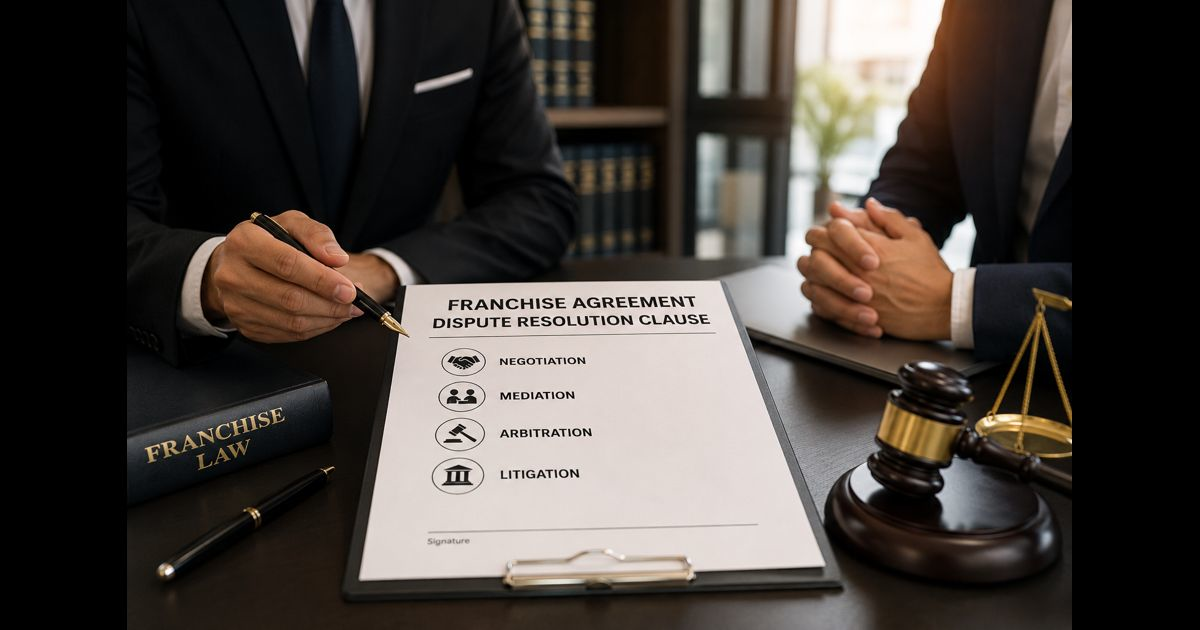
A franchise agreement dispute resolution clause sets the process that franchisor and franchisee must usually follow when a disagreement arises. It may require written notice, direct negotiation, mediation, arbitration, court proceedings, or a defined sequence of these steps. It can also determine where a case is heard, which law applies, who pays certain costs, and whether either party may seek urgent court relief.
That makes the clause more than a procedural detail. A dispute about royalties, territory, supplier restrictions, brand standards, renewal, termination, transfer, advertising contributions, or post-termination obligations can be shaped by this section before either side reaches the merits of the disagreement.
The agreement, the Franchise Disclosure Document, applicable federal law, and the law of the relevant state should be read together. A clause may be broadly written, but its enforceability and practical effect can depend on the facts, the claim, and protections that cannot legally be waived.
Start With the Exact Contract Language
A dispute-resolution provision should be read alongside the definitions, notice section, default and cure provisions, termination section, governing-law provision, venue clause, and any guarantee or related agreement. A single sentence can change the result.
For example, these differences matter:
- “May submit” can create a choice; “shall submit” usually signals a requirement.
- “Arising under this agreement” may be narrower than “arising out of or relating to the franchise relationship.”
- A provision requiring mediation before filing a claim can delay litigation if its conditions have not been met.
- An exception for injunctive relief may permit a court filing for limited urgent protection while the remaining dispute proceeds elsewhere.
- A clause naming a forum in the franchisor’s home state can materially affect travel, counsel, witnesses, and cost.
Do not assume that the heading tells the full story. The operative wording, defined terms, exceptions, and incorporated rules matter most.
The Usual Stages of a Franchise Dispute
Many agreements establish a sequence rather than one immediate forum. A typical structure can include the following stages.
Written Notice and Opportunity to Cure
The first requirement may be a written notice identifying the alleged default, the supporting facts, and the action needed to cure it. The notice provision may prescribe the delivery method, recipient, address, and time period.
A missed notice requirement can create unnecessary arguments about whether the dispute was properly initiated. Preserve proof of delivery, the complete correspondence, and any response. Where the disagreement concerns a curable operational or payment issue, the cure period may be as important as the later dispute forum.
Good-Faith Discussion
Some agreements require senior representatives to try to resolve the matter before mediation or arbitration. This stage can be useful where the parties need a practical solution that a court or arbitrator may not be able to create easily, such as a revised implementation timeline, a negotiated transfer, a temporary operational arrangement, or a structured payment plan.
The parties should identify the disputed provision, the remedy sought, and the documents that support each position. An informal discussion does not require abandoning legal rights or admitting liability.
Mediation
Mediation uses a neutral facilitator to help the parties negotiate a voluntary resolution. The mediator does not decide who wins. A settlement occurs only if the parties agree.
For franchise disputes, mediation may help preserve a business relationship that is still operating. It can also permit tailored solutions, including a transition, revised obligations, a release, a payment arrangement, or an agreed exit. The agreement should state how a mediator is selected, where the session occurs, how costs are shared, when mediation must begin, and when it is considered unsuccessful.
A mediation provision should also be checked for exceptions. A party seeking immediate protection of confidential information, trademarks, customer data, or post-termination restrictions may argue that waiting for mediation would cause harm that money damages cannot fully repair.
Arbitration
Arbitration is a private adjudicative process in which a neutral arbitrator, or panel, decides the dispute. The result is commonly binding, and the ability to challenge an award is usually much narrower than an ordinary appeal from a court judgment.
An arbitration clause should identify:
- The administering organization, if any
- The rules that govern the proceeding
- The seat or location of arbitration
- The number and qualifications of arbitrators
- The scope of disputes covered
- Whether emergency or interim relief is available
- The permitted extent of document exchange and depositions
- Fee allocation and arbitrator compensation
- Confidentiality obligations
- Whether class, collective, or representative proceedings are addressed
- The relationship between arbitration and court proceedings to enforce or challenge an award
Arbitration is not automatically cheaper. It may reduce some court-related delay and formal discovery, but commercial filing fees, arbitrator fees, expert costs, document production, and attorney fees can still be substantial.
Litigation
A clause may direct disputes to state or federal court, either generally or for defined claims. It may also reserve court proceedings for temporary restraining orders, preliminary injunctions, enforcement of an arbitration award, or claims that cannot be arbitrated.
Court proceedings offer formal discovery, motion practice, and appellate review. They can also be public and time-consuming. Venue and governing-law provisions should be reviewed carefully because they may affect the cost and legal rules that apply.
Mediation, Arbitration, and Litigation Are Not Interchangeable
|
Method |
Who decides the outcome? |
Is a result imposed? |
Main practical feature |
|
Negotiation |
The parties |
No |
Direct business resolution |
|
Mediation |
The parties, with a neutral facilitator |
No |
Flexible settlement options |
|
Arbitration |
Arbitrator or panel |
Usually yes |
Private process with limited review |
|
Litigation |
Judge or jury |
Yes |
Formal court process and appeal rights |
The appropriate route is not selected only by preference. The agreement’s wording, the claim, applicable law, urgency, and any enforceability issue all matter.
Forum, Governing Law, and Venue Can Change the Practical Burden
A governing-law clause identifies the substantive law chosen for the contract. A forum-selection or venue clause identifies where a court case must be filed. An arbitration clause may separately designate a city, county, or state for hearings.
These provisions can influence:
- Local counsel and travel costs
- Access to witnesses and records
- Available statutory protections
- Rules concerning termination, nonrenewal, transfer, or waivers
- The speed and cost of emergency relief
- Whether a state restricts out-of-state forum or choice-of-law provisions in franchise agreements
A forum clause does not eliminate the need to assess applicable law. Some states provide franchise-specific protections, and their effect can depend on the franchise location, the claim asserted, and the wording of the statute. A clause should therefore be evaluated in the actual jurisdictional context rather than treated as self-executing.
The Relationship Between the FDD and the Signed Agreement
Item 17 of the Franchise Disclosure Document summarizes provisions concerning renewal, termination, transfer, and dispute resolution. It is a useful starting point because it highlights where relevant subjects appear in the agreement.
However, the signed franchise agreement and related documents contain the complete operative language. The Item 17 table should be compared against the agreement to identify:
- The stated dispute-resolution method
- Arbitration or mediation requirements
- Choice of forum
- Governing-law provisions
- Limitations periods
- Termination and cure rights
- Transfer and renewal conditions
- Post-termination obligations
A summary does not replace a close review of the underlying contract. Differences among the franchise agreement, addenda, guarantees, development agreements, lease provisions, and later amendments can matter.
Emergency Relief and Carve-Outs Need Special Attention
Many franchise agreements exclude certain claims from the ordinary mediation or arbitration path. These carve-outs often concern alleged misuse of trademarks, confidential information, trade secrets, customer data, noncompetition duties, nonsolicitation duties, or post-termination de-identification obligations.
The key questions are precise:
- Which claims are excluded?
- Can either party seek emergency court relief, or only one?
- Is the court action limited to temporary relief?
- Must the remaining claims proceed to mediation or arbitration?
- Does the agreement require a bond?
- What factual showing is needed before emergency relief is available?
An exception should not be assumed merely because a matter feels urgent. The contract and applicable procedural rules control.
Costs, Fees, and Time Limits Should Be Reviewed Early
A dispute clause may allocate mediation fees, arbitration fees, attorney fees, expenses, or court costs. It may require the parties to split an arbitrator’s fees initially, subject to a final allocation in the award. It may also include a contractual deadline for asserting claims.
These provisions deserve early attention because an otherwise valid claim can become difficult to pursue if a notice deadline, cure period, filing deadline, or service requirement is missed. Parties should preserve:
- The complete signed agreement and amendments
- The FDD received before signing
- Notices of default, termination, or nonrenewal
- Royalty reports, invoices, audit materials, and payment records
- Operations communications and brand-standard notices
- Territory maps, supplier communications, and marketing materials
- Meeting notes and correspondence
- Evidence relevant to claimed losses or requested relief
Records should be preserved in their original form where possible. Deleting messages, altering files, or withholding relevant records can create serious problems in any forum.
Common Weaknesses in Dispute-Resolution Clauses
A clause may create uncertainty when it does not clearly address essential details. Common concerns include:
- Vague language about whether mediation is mandatory
- No clear deadline for initiating mediation
- No mechanism for selecting a mediator or arbitrator when the parties disagree
- Conflicting provisions across the franchise agreement and related documents
- An unclear scope of claims covered by arbitration
- An undefined emergency-relief exception
- No stated rules or administering organization
- Ambiguous fee allocation
- A distant forum with no explanation of how remote participation will work
- A confidentiality provision that is broader than necessary
- A shortened limitations period that may conflict with applicable law
Clear drafting does not guarantee enforceability, but it reduces avoidable procedural disputes and gives both parties a more predictable process.
A Practical Review Before Signing or Responding to a Dispute
Before signing a franchise agreement, compare the dispute-resolution section with Item 17 of the FDD and ask:
- Is mediation required before arbitration or litigation?
- Which disputes must be arbitrated, and which are excluded?
- Where must mediation, arbitration, or litigation occur?
- Which state’s law applies?
- Who selects and pays the mediator or arbitrator?
- Are attorney fees or costs recoverable?
- Is there a contractual deadline to bring a claim?
- Are urgent injunctions permitted in court?
- Does the clause limit class, collective, or representative proceedings?
- Do state franchise laws affect the clause’s enforceability?
When a dispute has already begun, avoid reacting only to the substance of the allegation. First identify every contractual deadline, notice requirement, cure right, and mandatory pre-filing step. A franchise lawyer licensed or experienced in the relevant jurisdiction can assess how the contract and applicable law interact with the specific facts.
Final Thoughts
A franchise agreement dispute resolution clause can determine the earliest decisions in a conflict: what notice is required, whether the parties must mediate, where a claim proceeds, which law may apply, and whether court relief remains available for urgent issues.
The strongest approach is careful and early review. Read the full agreement, compare it with the FDD’s Item 17 disclosure, preserve records, comply with procedural requirements, and obtain jurisdiction-specific legal advice before waiving rights, signing a settlement, or allowing a deadline to pass.
Frequently Asked Questions
Can a franchisee sue if the agreement requires arbitration?
Possibly, but the answer depends on the arbitration clause, the claims, any exception for court relief, and applicable law. A court may be asked to decide threshold issues or to enforce an arbitration requirement, while the merits proceed in arbitration.
Is mediation binding in a franchise dispute?
Mediation itself is generally nonbinding. A written settlement signed by the parties can be binding.
Does Item 17 of the FDD control the dispute process?
Item 17 provides an important summary, but the signed agreement and related documents contain the operative contractual terms.
Can a dispute clause require a case to be heard in another state?
It may attempt to do so, but the effect of an out-of-state forum provision can depend on the agreement, the claim, and applicable franchise law.
Can an arbitration award be appealed?
Review is generally limited. Under the Federal Arbitration Act, courts may vacate an award only on specified grounds, including corruption, evident partiality, certain misconduct, or an arbitrator exceeding authority.