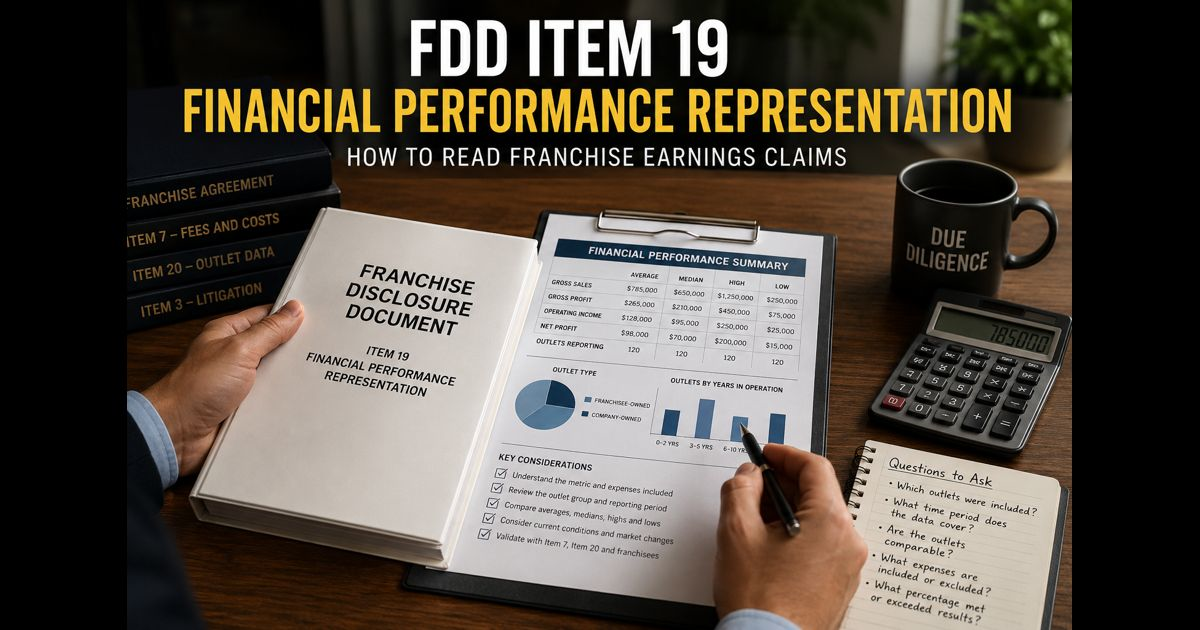
An FDD Item 19 financial performance representation is the part of a Franchise Disclosure Document that may report actual or potential financial results for franchised or company-owned outlets. It is commonly called an FPR or an earnings claim.
Item 19 can be valuable because it may show sales, costs, gross profit, operating income, or other business measures from outlets in the franchise system. It is not, however, a promise that a new franchisee will achieve the same result. A number can be accurate and still have limited relevance if the represented outlets differ materially from the business a buyer plans to open.
Under the FTC Franchise Rule, a franchisor is not required to provide an FPR. But if it makes a financial performance claim, the claim must have a reasonable basis, be supported by written substantiation, and appear in Item 19, subject to limited exceptions. The FTC does not approve the figures or certify that the franchise will be profitable.
What an Item 19 Financial Performance Representation Can Include
An FPR may address actual or potential performance, including:
- Gross sales or revenue
- Gross profit
- Net profit or net income
- Operating income
- Expenses or selected cost categories
- Average, median, high, or low results
- Sales-per-unit, customer-count, or other operating data tied to financial performance
- Forecasts or projections based on stated assumptions
The label matters less than the calculation. “Average sales” is not the same as average profit. “Net profit” may exclude costs that a prospective owner will actually bear. A reader should identify precisely what the figure measures before using it in a financial decision.
Item 19 Is Optional, but Unsupported Earnings Claims Are Not Acceptable
A franchisor may choose not to make a financial performance representation. In that event, Item 19 generally includes the prescribed statement that the franchisor does not make representations about future franchisee performance or the past performance of company-owned or franchised outlets.
The absence of Item 19 does not automatically prove that an opportunity is unsuitable. A newer system may lack sufficient operating history, or a franchisor may not have reliable and consistent data. It does mean a buyer has less disclosed financial evidence to evaluate.
A different concern arises when Item 19 says no FPR is made but a salesperson, broker, webinar, slide deck, email, or social-media post supplies sales, income, or profit figures. The FTC explains that financial claims generally must be included in Item 19; claims made outside it should be treated carefully.
Historical Results and Forecasts Need Different Questions
Historical performance reports what identified outlets achieved during a completed period. It may be useful evidence, but it does not account automatically for the buyer’s location, launch timing, financing costs, staffing, management ability, lease terms, or local demand.
A forecast estimates future results. It depends on assumptions. Those assumptions may involve opening date, customer volume, prices, labor, rent, marketing, supplier costs, seasonal demand, and the owner’s operating choices.
For either type of representation, ask:
- Which outlets were included?
- What dates does the data cover?
- How many outlets were eligible, and how many reported data?
- What percentage achieved or exceeded the stated result?
- Are the outlets comparable to the proposed location?
- Which expenses are included or excluded?
- Has anything changed since the reporting period?
A useful Item 19 makes those questions easier to answer. A headline figure without context should not be used as a stand-alone investment model.
Start With the Outlet Group
The most important question is often not “What is the average?” but “Average for whom?”
A system may include mature franchisee-operated outlets, newer locations, company-owned units, traditional sites, nontraditional sites, outlets in different regions, or units with different service models. Their results may not be comparable.
For example, an Item 19 that combines mature, high-volume urban locations with newer suburban outlets may produce an overall average that does not reflect either group well. Similarly, company-owned outlets may have different staffing, purchasing arrangements, owner compensation, rent, advertising contributions, or management resources from a franchisee-owned business.
Look for the following details:
- Number of outlets in the system
- Number included in the calculation
- Number excluded and why
- Franchisee-owned versus company-owned outlets
- Years in operation
- Geographic markets
- Unit format or location type
- Whether the outlets were open for the full reporting period
The smaller or more selective the sample, the more important the explanation becomes.
Do Not Confuse Revenue With Profit
Gross sales show money received from customers before many business costs. They can demonstrate demand, but they do not establish what an owner keeps.
Profit measures can be more informative, but only when the article or table clearly defines the costs deducted. A franchisee’s actual financial position may be affected by:
- Cost of goods or inventory
- Payroll, benefits, and contractor costs
- Rent, utilities, insurance, and repairs
- Royalties and advertising-fund contributions
- Local marketing
- Technology, payment-processing, and software fees
- Taxes
- Interest and loan payments
- Depreciation and amortization
- Owner compensation
- One-time opening, remodeling, or replacement costs
A sales figure can support a productive discussion of potential economics, but it cannot answer the profitability question by itself. Compare Item 19 against the expected costs disclosed in Franchise Fees and Costs: Assess the Full Investment, especially the estimates in FDD Item 7.
Read Averages, Medians, Highs, and Lows Together
An average can be pulled upward by a small number of unusually successful outlets. A median identifies the middle result after all results are arranged from lowest to highest. Neither figure is sufficient alone.
The range is equally important. If the highest-performing outlet earned substantially more than the typical location, a buyer should understand what conditions explain the difference. Conversely, low results may reveal risks that an average hides.
Ask whether the disclosure states:
- The average and median
- Highest and lowest results
- The number and percentage of outlets reaching the stated figure
- Whether results are grouped by age, format, region, or other material characteristic
- Whether closed, transferred, or underperforming outlets are excluded
The goal is not to find a single “correct” number. It is to understand distribution, variation, and the conditions behind the results.
Examine the Reporting Period and Current Conditions
A representation can be correctly calculated but stale or incomplete for the current market. Revenue, margins, labor costs, rent, financing rates, supply costs, and consumer demand can change materially over time.
Check the precise reporting period. Then identify changes since that period, including:
- Price increases or discounting
- New competitors
- Labor-cost changes
- Supplier or product-cost increases
- Required technology or remodel expenses
- Changes in royalty or advertising obligations
- Territory changes
- Changes to the operating model
- Recent outlet openings, closures, transfers, or conversions
A figure from a completed year is historical evidence, not a substitute for a location-specific budget based on current conditions.
Compare Item 19 With Item 7 and Item 20
Item 19 becomes more meaningful when read with the rest of the FDD.
Item 7 estimates the initial investment required to open the franchise. Compare that investment with the time needed to reach stable operations, the working-capital estimate, and the possibility that actual startup costs may exceed the disclosed range.
Item 20 reports system growth, transfers, terminations, non-renewals, reacquisitions, and outlet information. It also identifies current and former franchisees who may be contacted. High sales numbers should be considered alongside the system’s opening, closure, and turnover patterns.
Item 3 may disclose qualifying litigation involving the franchisor or certain related parties. It does not prove wrongdoing, but it can provide context for questions about royalties, territory, support, termination, or other franchise relationship issues. Franchise Disclosure Document Item 3: How to Evaluate Litigation History
A careful review connects the financial claim to the investment required, operating risks, system history, and franchise agreement.
Speak With Current and Former Franchisees
Item 20 contact information is one of the most useful tools for testing whether an FPR reflects the experience of comparable outlets.
Conversations should be respectful, focused, and independent. Ask about facts the FDD cannot fully convey:
- Startup costs and opening delays
- Time to reach stable sales
- Labor availability and turnover
- Local marketing requirements
- Required purchases and supplier pricing
- Actual recurring fees
- Seasonal changes
- Support received from the franchisor
- Whether the Item 19 group resembles their location
- Reasons for any transfer, closure, or non-renewal
Do not request confidential information or assume a small number of conversations represents the entire system. Speak with a varied group, including newer and more established operators where possible.
Warning Signs That Require Closer Review
No single issue decides whether an opportunity is sound. These situations warrant closer examination:
- A revenue figure is presented as though it were profit.
- The sample excludes a significant portion of operating outlets without a clear explanation.
- Company-owned results are presented without addressing material differences from franchisee-owned operations.
- High performers receive most of the attention while the range and attainment rate are unclear.
- The data period is old relative to material changes in costs or operations.
- A salesperson provides financial claims not found in Item 19.
- A projection does not identify its assumptions or supporting basis.
- The projected result cannot be reconciled with Item 7 startup and operating costs.
- Item 20 shows turnover or closures that are not explored.
These are questions to investigate, not automatic conclusions.
A Practical Way to Use the Numbers
A disciplined review separates disclosed facts from assumptions.
First, identify the actual financial metric. Next, identify the outlet group, reporting period, exclusions, and attainment rate. Then compare the result with a conservative, location-specific operating budget that includes all expected costs, sufficient working capital, and a margin for delays or weaker-than-expected sales.
The buyer should also consider how much capital may be at risk if the business takes longer than planned to reach break-even. Financial projections are most useful when they are stress-tested: lower sales, higher labor costs, delayed opening, higher rent, and additional working-capital needs.
This broader approach forms part of sound franchise due diligence. Item 19 is important evidence, but it should not carry the entire decision.
Frequently Asked Questions
Is an Item 19 financial performance representation required?
No. The FTC Franchise Rule permits, but does not require, a franchisor to make an FPR. A franchisor that does not make one generally must include the required no-representation disclosure in Item 19.
Does Item 19 tell me how much I will earn?
No. It may report actual results or a forecast under stated assumptions, but it does not guarantee the performance of a new franchise location.
Can a franchisor show gross sales without showing profit?
Yes. Gross sales and profit are different financial measures. A buyer should determine which operating expenses, fees, taxes, financing costs, and owner compensation are included before drawing conclusions about profitability.
Can a franchise salesperson give earnings figures outside Item 19?
Financial performance claims generally must be included in Item 19. Limited exceptions may apply, including actual records for a specific existing outlet offered for sale and certain written supplemental representations connected to an Item 19 disclosure. The exact facts and applicable state law matter.
What should I compare Item 19 against?
Compare it with Item 7 startup costs, Item 20 system data and franchisee contacts, Item 3 litigation disclosures, the franchise agreement, current local operating costs, and independent professional advice suited to the transaction.
Final Thoughts
An FDD Item 19 financial performance representation can provide useful evidence about a franchise system, provided it is read in context. The strongest review focuses on the metric, sample, time period, exclusions, expenses, achievement rate, and current operating conditions. It also tests the disclosure against the rest of the FDD and direct conversations with a varied group of current and former franchisees.
This article is general educational information, not legal, tax, accounting, or investment advice. Franchise disclosure and registration requirements can vary by state and transaction.